Click this category button to read more about the cohousing in the Village Blog.
Cohabitation, a concept of participatory housing
Composed of a social, environmental, and economic pillar, the cohousing represents a housing solution of the future.
Origin and Definition
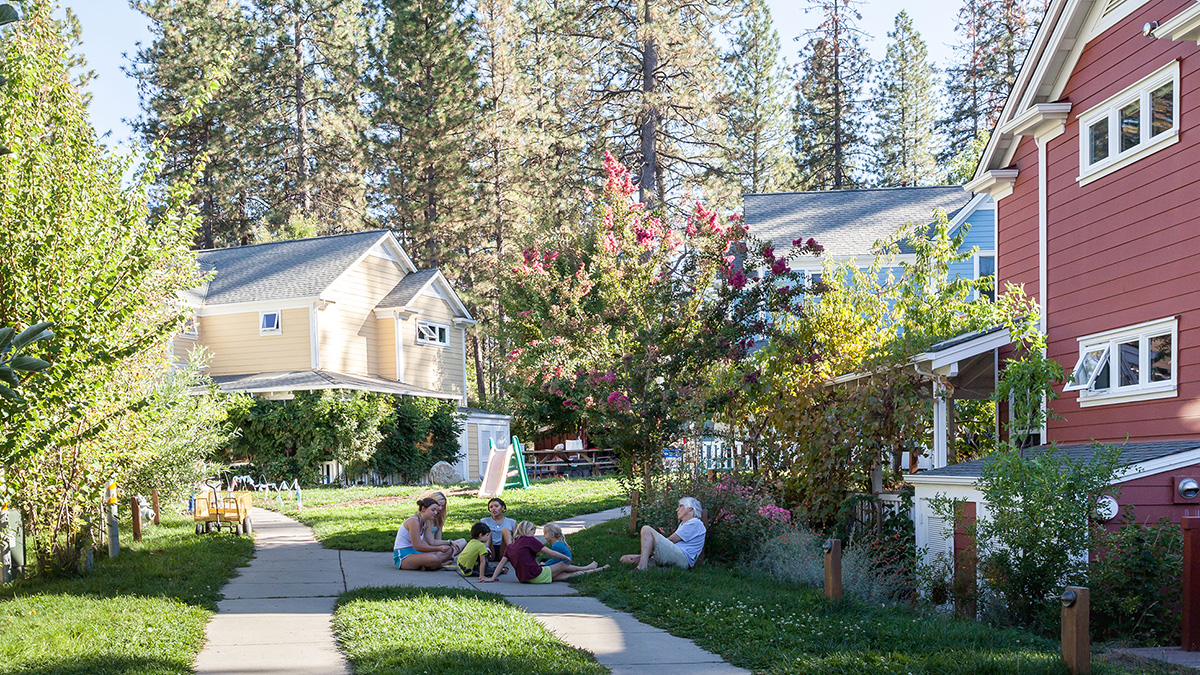
The cohousing concept, which originated in Denmark in the 1970s, is very simple yet immense: it aims to redefine living together. Cohousing directly refers to a neighborly cohabitation.Called «cohousing» in English Canada, the United States, and England, and "habitat groupé" or "autogéré" in French-speaking Europe, the concept is distinguished by its participatory process. Its occupants organize the design of their housing and are responsible for it. Project design prioritizes community spirit by including common spaces that meet the needs established by the group, with each person living in their individual space.
Co-housing does not have legal status; it is a way of life.
The structure
A cohousing project will include individual inhabited units and other shared units. A cohousing project will also be developed taking into account principles of sustainable development, and the design will include as many outdoor as indoor spaces. Regardless of the project, the common area will be the central space. The space will serve as a multifunctional center: ua large communal kitchen, a large central island for cooking and socialize, a room where a crowd of activities will take place, office nooks, a living space for receiving guests, a community garden serving as a pantry, a corner librarye...The form that the cohousing project takes will only be limited by what we set for ourselves or by the financial resources achieved.
The history
«In Denmark, over 50,000 people currently live in cohousing, representing about 1.5% of the population. In this country, as well as in Germany, France, and Belgium, governments facilitate the establishment of this type of housing. Banks see cohousing as an advantage, as people pay for their property even before the first shovelful of earth is turned. In Quebec, the government provides no assistance to encourage the emergence of this model, which nevertheless effectively addresses several contemporary issues, such as loneliness and soaring real estate prices. In the United States, 165 such models are in place, and another 140 are in the planning stages. Here, we have two completed projects: Cohabitat Québec and Cohabitat Neuville, both located in the Quebec City region.»[1].
Quebec, in search of a lost identity
Co-housing is a living environment designed by people seeking a balance between sharing individual and collective spaces. With only two projects built in Quebec, and a third soon to be built in Montreal, Quebec remains hesitant when it comes to co-housing. The single-family home remains the firm favorite. Why?
With the dismantling of customs inherent to the Catholic religion and the rise of individualism, our reference points have shattered; social identity has taken a hit. Once, we were community even without realizing it. If you are from the baby boomer generation or around that age, as a child you surely witnessed the big Sunday gathering where on the church steps, ladies in their finest attire chatted among themselves while the gentlemen loudly discussed a few feet away. In short pants or lace dresses, you had that blissful feeling of being part of a village, a community. Then there were all those sweet moments when we spied on our parents and their friends having lively card games, sometimes quite well-lubricated, or when we found it amusing but ‘normal’ for visitors to drop by unannounced on Sundays after mass, happy to chat over bad coffee, not to mention all the birthdays that HAD to be celebrated.
We lived within a reassuring collective enclosure. We were a community.Then religion faced the well-known excesses, families dispersed, and children living miles apart see their parents occasionally. Slowly but surely, we embraced an individualistic lifestyle: everyone their own yard, their own BBQ, and increasingly enclosed outdoor spaces. We find ourselves, sometimes two of us, alone to ‘juggle’ what our future will be, or what's left of it.
Seniors are particularly impacted by this socio-cultural change where we've gone from village life to individuality, expressed by the type of property occupied.
Beyond the current offering
Grappling with an economic climate marked by uncertainty, a worsening climate crisis, and homes that are too large and difficult to maintain, aging individuals are seeking alternatives to the current offerings.
Hardcore co-housing advocates near our place
In Lanaudière, the Cohabitat Village VITAL collective took shape in the spring of 2023 when it became a nonprofit cooperative. It offers seniors an alternative to living in a retirement home or alone in their own homes. Learn more about how to become a member.
[1] Sources: Cohousing is multiplying in Quebec despite obstacles, April 3, 2023 Le Devoir,